How AI is changing design maturity
AI has made it dramatically easier to create things that look designed. You can generate a user interface, explore concepts, build a prototype, rewrite content, synthesize research, or come up with ten alternative solutions in minutes. But it raises an interesting question:
If everyone can do more design, does that mean organizations are becoming more design-mature?
I don’t think the answer is simple. In fact, I think AI is changing what we should mean by design maturity in the first place.
So, what is design maturity?
Before looking at how AI changes it, it is worth taking a step back.
Design maturity is, broadly speaking, about how deeply design is integrated into an organization. It is not simply about having designers on staff or using a particular design process. It is about whether an organization has the ability to use design knowledge and user-centered thinking to make better decisions.
A less mature organization might bring design in late, when a solution has already largely been decided.
A more mature organization might involve users earlier, use research to understand problems, prototype and test ideas, and give design a meaningful role in product or service decisions.
At an even more mature level, design becomes part of the organization's way of thinking. Teams across the organization are able to frame problems, challenge assumptions, explore alternatives, and learn from users. Even design with users.
In other words, design maturity is not really about how much design an organization produces. It is about how well the organization uses design to understand and act on complex problems. And this distinction becomes particularly important in the age of AI.
From "doing design" to "knowing what to design".
Before generative AI became widely available, many design activities required specialized skills. You needed a designer to create a wireframe. A UX researcher to structure and analyze research. A content designer to work on the language. A prototyping tool — and someone who knew how to use it. AI is changing that.
Today, a product manager can ask an AI tool to generate a prototype. A developer can explore several interface concepts. A business analyst can synthesize interview notes. A subject-matter expert can generate alternative service flows. The barrier to producing design has fallen significantly. But producing a design has never been the hardest part of design. The harder questions are often:
What problem are we actually solving?
For whom?
Why is this problem worth solving?
What do we actually know about the people affected by it?
Which assumptions are we making?
What would happen if we solved the wrong problem?
AI is useful when the problem is reasonably well understood, and we need to explore possible solutions. It is much less useful if the organization has not yet figured out what it should be solving. This creates a shift in where design expertise matters.
AI lowers the barrier to design — and raises the bar for design expertise.
There is an apparent paradox here.
On one hand, AI democratizes design. More people can use design methods. More people can prototype. More people can explore ideas. Design becomes less dependent on specialized production skills. On the other hand, as design production becomes easier, the ability to judge, question, and contextualize design becomes more important.
When anyone can generate ten possible solutions, the valuable question is no longer:
"Can we come up with a solution?"
It becomes:
"Which problem are we solving, what do we know about it, and how do we know whether any of these solutions are actually useful?"
This puts more emphasis on things that are harder to automate, like:
understanding context
framing problems
identifying assumptions
interpreting human needs
navigating conflicting needs
understanding competing needs and making informed trade-offs
understanding organizational constraints
helping teams make better-informed decisions
testing ideas with real people
knowing when the evidence is insufficient
In other words, AI may reduce the value of design as production, while increasing the value of understanding and evaluating design.
The risk of design illusion.
This also creates a new kind of organizational risk. Let's imagine an organization where product owners, developers, and managers suddenly have access to powerful AI design tools. They can produce beautiful interfaces, generate personas, create customer journeys, and produce polished prototypes before lunch.
From the outside, this organization might look highly design-mature. But what if none of those activities are grounded in actual user research? What if the personas are assumptions generated by an AI? What if the customer journey reflects the organization's internal process rather than the user's experience? What if the prototype has never been tested with anyone?
The organization may have increased its design output without increasing its design capability. The gap between design production and design knowledge might be getting bigger. This gap has already existed for a long time, but AI can make it harder to see.
A new kind of design maturity
This suggests that traditional models of design maturity may need to evolve.
Historically, we might have described design maturity something like this:

Non-design: Design work is often outsourced and not applied systematically.
Design as form-giving / Design as production: Design is used as a “finishing touch” to style products and services.
Design as process / Design as a method: Design is integrated into development processes; methods for user research (like making prototypes and performing interviews or user tests) and analysis (affinity mapping, open coding, thematic analysis, user journeys, etc.) are used, and the design work is more iterative and collaborative.
Design as strategy: Design is a key strategic element in the business model. Methods are used to explore uncertainties and new markets, as well as to solve problems, improve working environments and processes, and explore new possibilities within the organization.
AI doesn't necessarily invalidate this model. But it changes the meaning of the early stages. When everyone can produce a reasonable prototype, having the ability to make prototypes is no longer a strong indicator of design maturity. The more interesting question becomes:
How does the organization decide when to prototype, what to prototype, and what to learn from it?
Likewise, having AI-generated user research summaries doesn't mean an organization is user-centered. The question is whether research actually influences decisions.
Having a design system doesn't necessarily mean design is mature. The question is whether the organization has a shared understanding of why and when its patterns should be used.
AI shifts the focus from whether an organization can perform a design activity to whether it understands the purpose and limitations of that activity.
The designer's role is changing too.
This naturally changes the role of designers. If AI can generate ten interface variations in seconds, producing the variations is no longer necessarily where the designer creates the most value.
The designer increasingly becomes the person who helps the organization ask better questions.
Not just:
"What should this screen look like?"
But:
"Should we have this screen at all?"
Not just:
"How can we improve this journey?"
But:
"Is this actually the journey our users need?"
Not just:
"Which of these concepts do we prefer?"
But:
"What evidence would help us decide?"
This doesn't make traditional design skills irrelevant.
Visual design, interaction design, prototyping and craft still matter. But their role changes when AI can accelerate the production of alternatives. The designer may increasingly become a facilitator of organizational sense-making — someone who helps teams navigate ambiguity, make assumptions visible, explore possibilities, and connect decisions to real human needs.
When design becomes a way of thinking.
Perhaps the most exciting consequence is that AI could help move us towards something design has talked about for a long time: design becoming a shared organizational capability.
If product managers can prototype, developers can explore interaction patterns, subject-matter experts can work with user journeys, and leaders can use AI to make assumptions explicit, design doesn't have to remain something that happens inside the design team. It can become a way of thinking across the organization.
But there is an important condition.
Democratizing design does not mean removing design expertise. It means distributing design capability while retaining design knowledge.
An organization where everyone has access to AI but nobody understands user research, design principles, accessibility, systems thinking, or human behavior is not necessarily design-mature. It may simply be very good at generating things.
The new question.
This is why I think AI changes the conversation around design maturity. For a long time, organizations could ask:
"Do we have design capability?"
Then perhaps:
"How well integrated is design into our organization?"
Now we also need to ask:
"What happens to our design capability when everyone has an AI design assistant?"
And perhaps the most important question:
"Are we using AI to make more things, or are we using it to make better decisions?"
AI can make design faster. It can make design cheaper. It can make design more accessible. It can help more people participate in design activities. But none of these things automatically make an organization more design-mature. If anything, the opposite may be true: as design production becomes easier, design maturity becomes less about the ability to produce and more about the ability to understand, question, decide, and learn.
That may be the biggest shift AI brings to design maturity.
The future of mature design organizations may not be the ones with the most designers, the most sophisticated design tools, or the most AI-generated prototypes. It may be the organizations that are best at combining human understanding, design judgment, and AI-enabled exploration — and at knowing when each of them is needed.
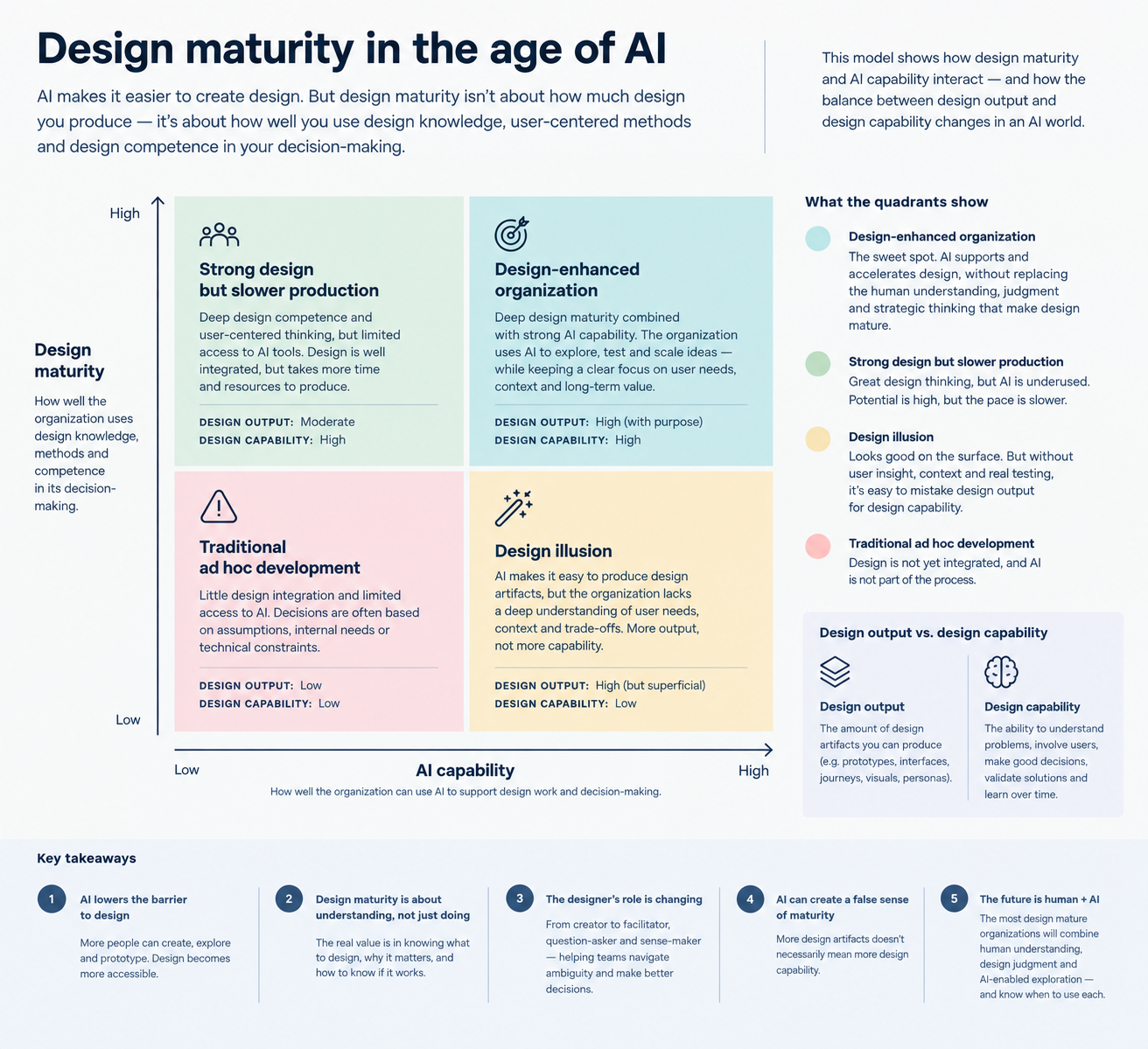
“How was AI used in the writing of this article?” you may ask. Well, I wrote a first draft of the article, then used ChatGPT to improve the language. Then I asked it to structure the article so that it was easier to read. I also asked it to come up with some of the example questions, as well as generate the image of the model.